Commercial Kitchens · 70 Miles of Peterborough
Commercial kitchen cleaning: the half most quotes leave out
Commercial kitchen cleaning is really two jobs. A deep clean covers the surfaces you can see — floors, walls, ovens and equipment — and is driven by your food hygiene rating. Extract cleaning covers the canopy, ductwork and fan that carry grease out of the building, and is driven by fire safety and your insurance policy. BlueTick does the second, to the BESA TR19 Grease standard, and issues the certificate that evidences it.
What commercial kitchen cleaning actually covers
Most kitchens buy these separately without realising they are separate. The confusion is expensive in one direction only: a deep clean will not satisfy an insurer asking for evidence that your ductwork has been cleaned, because a deep clean never touched it.
Kitchen deep cleaning
General commercial cleaners
- Floors, walls, ceilings and splashbacks
- Ovens, fryers, ranges and grills
- Shelving, cold rooms and food storage
- The visible underside of the canopy
Driven by: Food hygiene rating and day-to-day hygiene
Extract system cleaning
Specialist TR19 contractors
- Canopy interior, plenum and grease filters
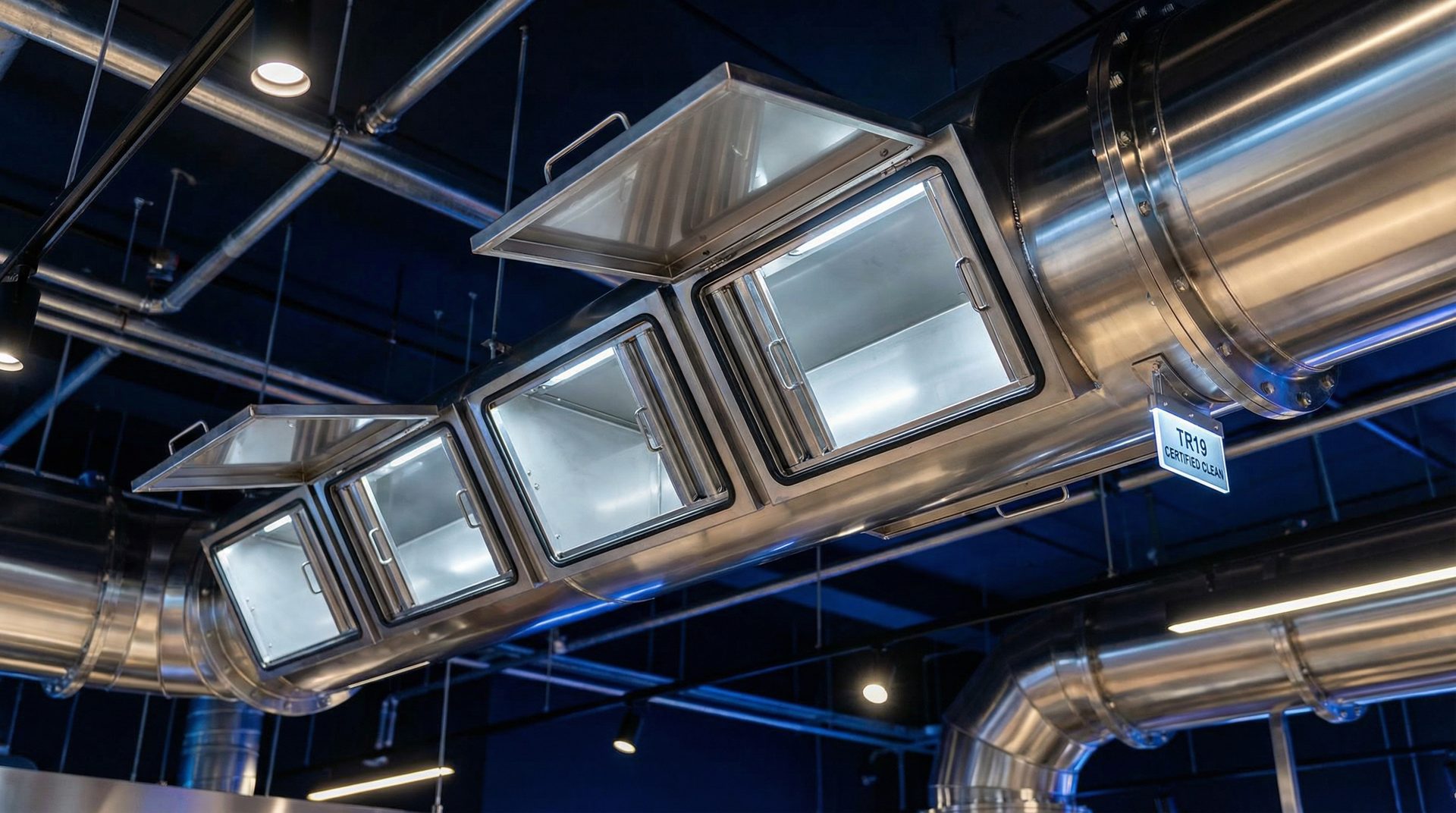
- The full ductwork run, not just the first metre
- Extract fan, impeller and motor housing
- Discharge point and any bends in between
Driven by: Fire safety and insurance compliance
This is what we do
If you are buying both, have the extract system cleaned first. Cleaning ductwork drops grease and debris onto everything beneath it, so a deep clean booked the day before gets undone.
Commercial kitchen deep clean vs TR19 extract clean
The difference that matters is how each one is judged. A deep clean is assessed by eye: the kitchen looks clean, and an environmental health officer is satisfied. A TR19 extract clean is assessed by measurement: grease depth is recorded in microns at named points before and after the work, and the readings go on the certificate.
That is why a deep clean cannot be substituted for an extract clean when an insurer asks for evidence. There is nothing to produce. The kitchen looked clean, but nobody measured anything, nobody opened the duct, and nobody wrote down what they found.
It also works the other way. We are not a general cleaning contractor, and a TR19 certificate says nothing about your floors, your cold room or your fryers. If your food hygiene rating is the problem, a deep cleaning company is the right call and we will say so.
How often does a commercial kitchen need its extraction cleaned?
BESA sets the interval by cooking hours per day, not by the type of food or the size of the kitchen. Count the hours the extraction actually runs, and read across.
| Usage | Cooking hours per day | Clean every |
|---|---|---|
| Heavy use | 12–16 hours per day | Every 3 months |
| Moderate use | 6–12 hours per day | Every 6 months |
| Light use | 2–6 hours per day | Every 12 months |
A busy takeaway or a hotel kitchen running services from breakfast to late evening sits in the top band. A cafe closing mid-afternoon usually sits in the bottom one. Where your policy specifies an interval, the policy wins — see what a TR19 certificate proves.
Choosing a commercial kitchen cleaning services provider
Extract quotes vary far more than they should, and almost always because they cover different amounts of the system. Five questions separate them.
- 1Ask what happens to the ductwork, not just the canopy. The canopy is the part you can see, and the part a cheap quote cleans.
- 2Ask whether the quote includes fitting access panels where there are none. Ductwork that cannot be reached will not be cleaned, and the certificate should say so.
- 3Ask for grease depth readings before and after, in microns, at named points — not a photograph of a shiny filter.
- 4Ask what the certificate says about areas that could not be accessed. A certificate with no exclusions on a system with no access panels is not telling you the truth.
- 5Check the frequency they recommend against how many hours a day you actually cook, not against what your last contractor happened to do.
Common questions
What does commercial kitchen cleaning include?
In practice it covers two different jobs done by two different trades. Kitchen deep cleaning covers the surfaces you can see — floors, walls, shelving, ovens, fryers and cold rooms. Extract cleaning covers the system that carries the grease away — canopy, filters, ductwork and fan. A deep clean does not clean the ductwork, and an extract clean does not degrease your floor.
Is a commercial kitchen deep clean the same as a TR19 clean?
No. A deep clean is a hygiene job, usually judged by eye and aimed at your food hygiene rating. A TR19 clean is a fire safety job on the extraction system, judged by measured grease depth and evidenced with a certificate. You may well need both, but one will not satisfy the requirement for the other.
How often should a commercial kitchen be cleaned?
Surfaces and equipment are cleaned daily by kitchen staff, with a deep clean typically quarterly. The extraction system is different: BESA sets the interval by how many hours a day you cook, from every 3 months for heavy use to every 12 months for light use.
Do I need a commercial kitchen cleaning company for my food hygiene rating?
An environmental health officer inspects cleanliness, structure and management, and a visibly greasy canopy will be noticed. But the rating scheme assesses food safety, not fire safety, so it is not the reason to have your ductwork cleaned — your insurance policy and your fire risk assessment are.
What should a commercial kitchen cleaning company give me afterwards?
For extract work, a certificate with pre and post-clean grease depth readings in microns, a plain statement of what was and was not cleaned, photographs, and a next-due date. For deep cleaning, a scope of works and a schedule. Anything with no measurements and no scope statement evidences very little.
Do you clean the whole kitchen or just the extraction?
Just the extraction system, and everything that forms part of it — canopy, filters, ductwork, fan, and the access panels needed to reach it. We do not clean floors, walls or catering equipment. If you need both, have the extract cleaned first: it is the job that drops grease onto everything underneath it.
Not sure which half of the job you need?
Send us a photograph of your canopy and your last certificate if you have one. We will tell you what your system needs and what it does not. Free site survey across Peterborough and everywhere within 70 miles, including Cambridge, Leicester, Nottingham, Northampton and Lincoln.