
BESA TR19 · Grease ·
Commercial kitchen duct cleaning in Peterborough
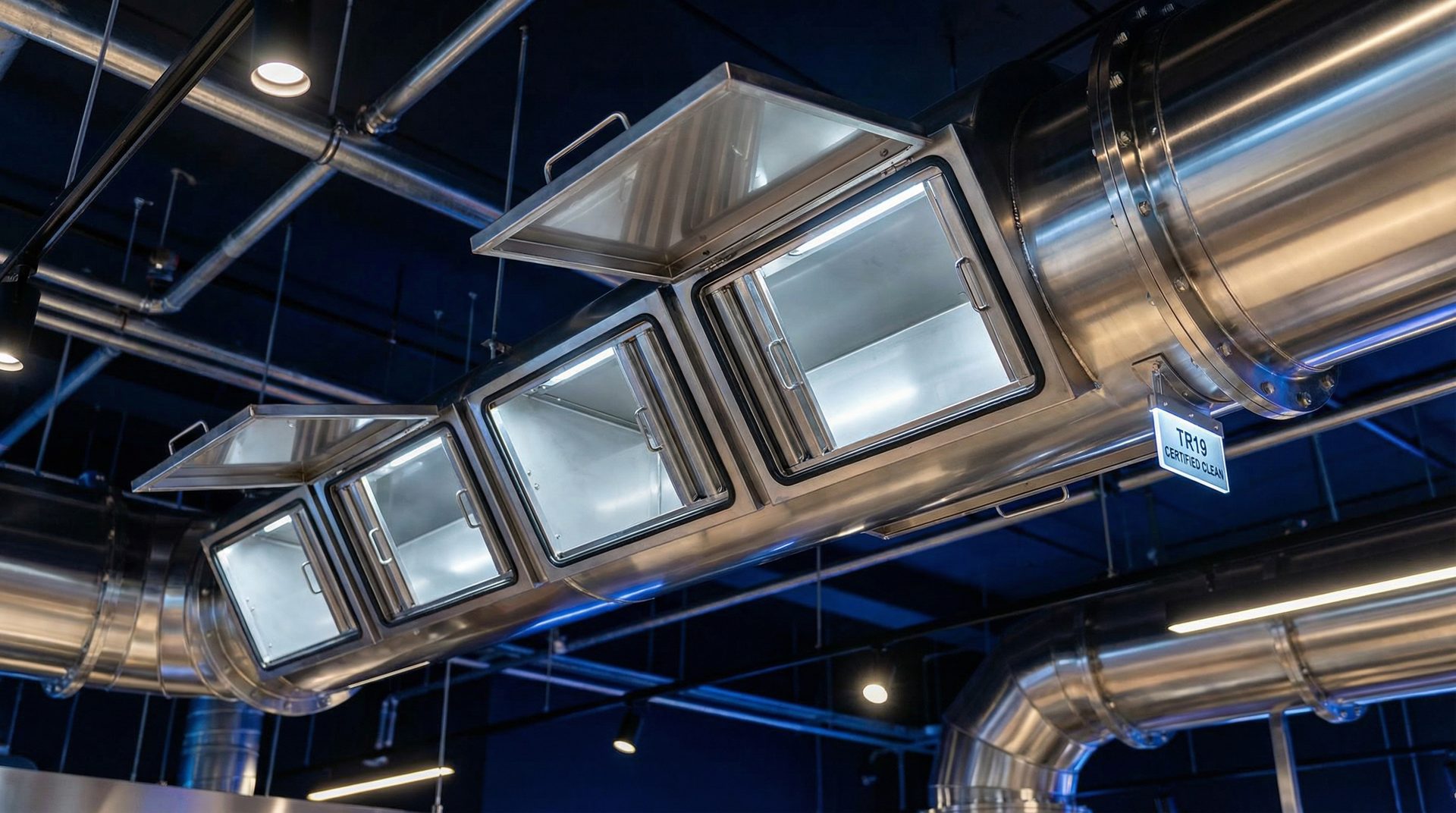
We clean the extract ductwork of restaurants, takeaways, pubs, hotels, care homes and schools across Peterborough and everywhere within 70 miles. Ductwork is the part of a kitchen extract system nobody sees and most quotes skip: grease builds up along its whole length, inside a sealed channel that runs through the building. We clean it to the BESA TR19 Grease standard — fitting access panels where there are none, measuring grease depth in microns before and after, and stating on the certificate exactly which sections were reached.
Commercial kitchens only. We do not clean household ducts, air conditioning or general ventilation.
Why ductwork is the part that gets left out
A canopy can be cleaned in an evening by anyone with a scraper and a degreaser. It is visible, it is reachable, and it is what the customer looks at afterwards. Ductwork is none of those things. It usually cannot be opened at all without cutting and fitting access panels, which costs money on the first visit and shows up on the quote.
So the cheapest quote is almost always the one that cleans the canopy, photographs the shiny result, and leaves the duct run as it was. The certificate still says the system was cleaned. What it should say — and often does not — is which sections were reached and which were not.
That gap matters because the duct is where accumulated grease does the most harm. A fire in a canopy is in the open, above a hob, in a room with people in it. A fire in a duct is inside a sealed metal channel that passes through walls and floors, and it travels.
What ductwork cleaning involves
Survey and access
We follow the duct run from canopy to discharge and find out what can actually be reached. Where panels are missing, we fit them to BESA specification — a one-off cost that makes every clean afterwards verifiable.
Measure before
Grease depth readings in microns at named points along the run, so there is a baseline. Without a before reading, an after reading proves nothing.
Clean back to metal
Mechanical agitation and hand scraping through the panels, working along the run. Filters, canopy plenum and the fan housing are done as one system, because grease left in the fan finds its way back into clean duct.
Measure after, and record
Post-clean readings at the same named points, photographs of every section opened, and a plain statement of anything that could not be reached and why.
Access panels are covered in more detail on our access panels page, and what ends up on the paperwork is covered under TR19 certificates.
TR19 grease: how it is measured, and why one number misleads
TR19 Grease is BESA's specification for fire risk management of grease accumulation within kitchen extraction systems. It judges a system by how much grease is sitting on the inside surfaces, measured as deposit thickness in microns (thousandths of a millimetre). The measurement is simple. Reading it honestly is the part that goes wrong.
What is measured
A deposit thickness gauge, often a wet film comb, is pressed into the grease on a duct or canopy surface and the depth is read off in microns. Each reading describes one spot on one surface, nothing more.
Where readings are taken
At named points along the whole system: the canopy plenum behind the filters, each duct section that can be opened, either side of bends where grease settles, and the fan housing. Our post-clean report lists every reading by component and measurement point, before and after, so the next contractor can go back to the same spots.
Why an average can hide the problem
Grease does not settle evenly. Horizontal runs, bends and the stretch near the fan load up faster than a vertical riser. Average a heavily loaded bend with several lightly loaded sections and the figure looks fine while one part of the duct is carrying most of the fuel. Read the individual readings, not just the average.
Why the figures online disagree
Search for TR19 grease and you will find several different micron figures, often presented as the pass mark. They describe different things: when a system is due a clean, when a single spot needs cleaning straight away, and what a cleaned surface should read. They are not interchangeable, and a figure quoted without saying which one it is tells you very little.
So we do not give a single number as the test. The certificate records the compliance statement for the clean, and the report behind it gives every before and after reading with its location, the photographs, and any section that could not be reached. What TR19 is and who publishes it is covered on what is BESA TR19, and where it sits against the law on TR19 regulations.
Kitchen extract ductwork, not general ventilation
"Duct cleaning" covers two different trades. Grease extract ductwork sits under BESA TR19 Grease and is what we do. General ventilation and air handling hygiene sits under TR19 Air and is a separate competency. We would rather tell you that than take work we are not the right contractor for.
What we clean
- Kitchen extract ductwork carrying grease-laden air
- Canopy plenum, grease filters and the duct behind them
- Extract fan, impeller and motor housing
- Riser sections and horizontal runs, through fitted access panels
- Discharge point and cowl
What we do not
- Air conditioning and air handling units
- General ventilation ductwork under TR19 Air
- Supply air and fresh air intake systems
- Dryer vents and domestic extractor fans
Kitchen duct cleaning near you
We are based in Peterborough (PE3 7PH) and clean kitchen extract ductwork within 70 miles. Towns within 45 miles are covered regularly; further out is booked on request, and sites near each other can share a trip. Each town page shows how many food businesses there are, who inspects them and which fire service covers them.
- Duct cleaning Peterborough
- Duct cleaning Market Deeping
- Duct cleaning Whittlesey
- Duct cleaning Stamford
- Duct cleaning Bourne
- Duct cleaning Spalding
- Duct cleaning March
- Duct cleaning Huntingdon
- Duct cleaning Wisbech
- Duct cleaning Corby
- Duct cleaning Oakham
- Duct cleaning St Ives
- Duct cleaning Kettering
- Duct cleaning Rushden
- Duct cleaning St Neots
- Duct cleaning Ely
- Duct cleaning Grantham
- Duct cleaning Wellingborough
- Duct cleaning Boston
- Duct cleaning Melton Mowbray
- Duct cleaning Sleaford
- Duct cleaning Market Harborough
- Duct cleaning King's Lynn
- Duct cleaning Cambridge
- Duct cleaning Bedford
- Duct cleaning Biggleswade
- Duct cleaning Northampton
- Duct cleaning Leicester
- Duct cleaning Newmarket
- Duct cleaning Newark
- Duct cleaning Loughborough
- Duct cleaning Milton Keynes
- Duct cleaning Nottingham
By county: Cambridgeshire, Lincolnshire, Northamptonshire, Rutland, Norfolk, Leicestershire, Bedfordshire, Suffolk, Nottinghamshire, Hertfordshire, Buckinghamshire, Warwickshire, Essex, Derbyshire, West Midlands, Staffordshire. Every place we cover is on the areas we cover map.
Kitchen duct cleaning: common questions
Do you do duct cleaning near me?
If your kitchen is within 70 miles of Peterborough, yes. We are based at PE3 7PH and work across Peterborough and the counties around it, including Cambridgeshire, Lincolnshire, Northamptonshire, Rutland, Leicestershire, Nottinghamshire, Bedfordshire and west Norfolk. Places within 45 miles are covered regularly; the rest are booked on request, and sites near each other can share a trip.
What does commercial duct cleaning involve?
Opening the ductwork at intervals along its length, cleaning the internal surfaces back to the metal, and measuring what was removed. On a kitchen extract system that means access panels at every bend and change of direction, mechanical agitation and scraping of the grease deposit, and grease depth readings in microns before and after at named points.
How long does kitchen duct cleaning take?
It depends on the length of the duct run, how many access panels it has and how much grease has built up. A first clean that needs panels fitting takes longer than a routine one. We tell you how long the kitchen will be out of use when we price the job after the survey, and we can work early morning, in the evening or overnight so you keep trading.
Do we have to close the kitchen?
Only while we are working, because nothing can cook under the canopy while the system is open. Most kitchens book the clean outside trading hours: early morning, after service or overnight.
What happens if kitchen ductwork is not cleaned?
Grease keeps building up inside the duct, where nobody sees it. It is fuel inside a sealed metal channel that runs through the building, so a fire that reaches it can travel. Extraction also weakens as the duct and fan clog. Your insurance policy may make regular cleaning a condition of cover, and the fire risk assessment the Regulatory Reform (Fire Safety) Order 2005 requires should take the extraction system into account.
How do I know if my ductwork needs cleaning?
Grease dripping from canopy joints or filters, a fan that is louder or pulls less than it did, cooking smells lingering in the kitchen, or a last clean longer ago than the TR19 interval for your cooking hours. If your last certificate does not say which duct sections were cleaned, assume the ductwork was not.
Do you clean air conditioning or general ventilation ductwork?
No. We clean grease-bearing kitchen extract ductwork to the BESA TR19 Grease standard. General ventilation and air handling hygiene is covered by TR19 Air and is a different service with different competencies. If that is what you need, we will tell you rather than take the work.
How much of the ductwork actually gets cleaned?
Only as much as can be reached. This is the single biggest difference between quotes and the reason a cheap clean is cheap. Where there are no access panels, whole runs of duct are left untouched, and the certificate should state which sections those were.
How often does kitchen extract ductwork need cleaning?
BESA sets the interval by cooking hours per day: every 3 months for heavy use at 12–16 hours, every 6 months for moderate use at 6–12 hours, and every 12 months for light use at 2–6 hours. Ductwork is cleaned on the same visit as the canopy and fan, as one system.
Can ductwork be cleaned without access panels?
Only the first stretch, reachable from the canopy or the fan. Anything beyond the first bend needs a panel. We supply and fit BESA-specification access panels as part of the work, which is a one-off cost that makes every future clean cheaper and verifiable.
What is TR19 Grease?
The BESA specification for fire risk management of grease accumulation within kitchen extraction systems. BESA released it as a stand-alone document in 2019, separate from TR19 Air, which covers general ventilation. It sets out how a kitchen extract system is inspected, cleaned and verified, from canopy to discharge. It is industry guidance rather than law; the legal duty is the fire risk assessment under the Regulatory Reform (Fire Safety) Order 2005.
How is grease thickness measured in kitchen ductwork?
With a deposit thickness gauge, often a wet film comb, pressed into the grease at a named point on a duct, canopy or fan surface, and read in microns. Readings are taken before cleaning and again after, at the same points, so the report shows what was removed where. A report that gives only an average, or does not say where readings were taken, cannot be checked.
Is there one grease thickness that means a duct passes TR19?
Not in the way it is often quoted. The micron figures you see online describe different things, such as when a system is due a clean, when one spot needs cleaning at once, and what a cleaned surface should read, and an average can hide one heavily loaded bend. Ask for every before and after reading with its location, the photographs, and a list of any sections that could not be reached.
What is ductwork hygiene?
The general term for keeping the inside of ductwork clean and documented. For kitchen extract it means controlling grease accumulation, because grease inside a duct is fuel in a sealed channel that runs through the building. The evidence of it is the post-clean report and certificate.
Find out how much of your ductwork has actually been cleaned
Send us your last certificate and we will tell you which sections it covers and which it quietly does not. Free site survey across Peterborough and everywhere within 70 miles, including Cambridge, Leicester, Nottingham, Northampton and Lincoln.